Victor
Soul Guardian: A Hellishly Cozy FantasyVictor is the ghost chef who haunts Bael-Sharoth’s new home and becomes, despite an emphatically unwilling beginning, his instructor in cooking eggs. His significance lies in the way he converts an apparently threatening supernatural presence into a domestic relationship: he interferes with breakfast, is physically subdued by a demon, teaches Bael-Sharoth how to prepare an omelet, and then retreats into a cookie jar when the household’s private intimacy becomes too embarrassing to witness.
Identity and Introduction
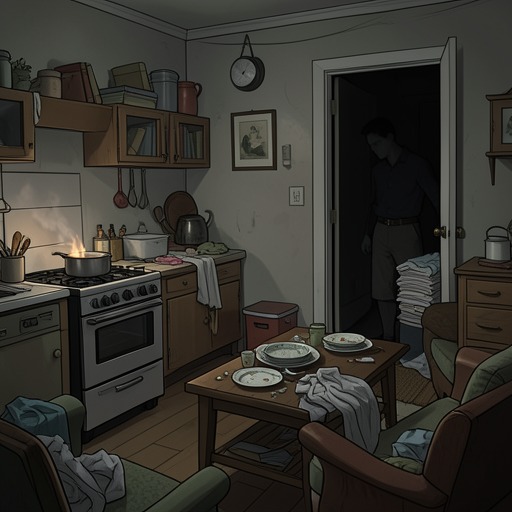
Victor first appears as one of the ghosts whose moans and wails lull Bael-Sharoth to sleep in his new recliner. The haunting is not presented as a solemn or purely terrifying intrusion. Instead, it forms the background to Bael-Sharoth’s unsuccessful attempts to cook breakfast, each effort ending in a blackened, inedible mess. Bael-Sharoth has already discovered an accidental advantage in this routine: the smoke tends to wake Maharet Flameheart, who can actually cook. The household’s supernatural disturbance is therefore folded into an absurdly ordinary domestic pattern before Victor is identified.
The immediate conflict begins when the carton of eggs Bael-Sharoth has placed on the kitchen counter vanishes. He distinguishes between threatening messages, which might be tolerated as part of a haunting, and interference with breakfast, which he treats as an unacceptable escalation. When the eggs return and then skitter away from his grasp, he answers the ghost’s prank with a salt shaker. The shattered salt and glass reveal Victor as a fat, confused ghost covered in salt like dust on a cobweb. Bael-Sharoth follows the revelation with a cast-iron frying pan, which passes through Victor harmlessly as hot oil does, while the iron strikes him hard enough to knock him over.
The Egg Lesson
Victor’s defeat does not end the encounter; it gives him a new function. Because demons can touch and harm ghosts even though humans cannot, Bael-Sharoth is able to seize Victor by the collar and demand an explanation for the attempt to play keep-away with his omelet. Victor’s first useful response is practical rather than mystical. He identifies the pan as too hot, recommends beginning at a lower heat, advises using butter instead of oil, and says that the eggs should come to room temperature. After delivering this message, he faints, only to be revived by a swift slap from Bael-Sharoth.
Bael-Sharoth then demands a complete explanation of egg cooking, specifically requiring Victor to explain it as though teaching a child. Victor reacts with horror and disbelief because he is a world-renowned chef, yet his astonishment confirms that the lesson is real: Bael-Sharoth is not merely interrogating a ghost but appointing one as a culinary mentor. The comic reversal is central to Victor’s characterization. His expertise gives him authority, but his ghostly status gives Bael-Sharoth physical power over him, placing a celebrated chef in the humiliating position of an unwilling student’s instructor.
Victor’s apprenticeship continues through a concrete shopping assignment. When Bael-Sharoth returns from walking uphill to the house with the requested provisions, he has obtained everything Victor asked for, including espelette, and is so hungry that he collapses onto a bar stool while asking to begin. Murphy is gone, the house is otherwise empty, and Victor stands cross-armed in the kitchen awaiting his student’s return. The scene makes Victor’s role unusually organized for a haunting: he sets requirements, waits for compliance, and assumes the posture of a teacher supervising a practical exercise.
For the first omelet, Victor sets the oven to 250 degrees Fahrenheit and places two heavy stoneware plates inside. The plates provide a warm place for the eggs, cheese, and ham while they come up to room temperature. He grates Gruyère and slices the ham into long, thin slivers, explaining that cold ingredients would cause the eggs to overcook before the filling became warm, gooey, and delicious. Victor’s instruction is therefore not ornamental expertise. It is a sequence of precise corrections to Bael-Sharoth’s earlier approach, replacing smoke, impatience, and brute force with controlled heat and preparation.
The result validates Victor’s authority. The eggs are light and fluffy, the center gooey, the ham’s smoke rolling over the rich, sweet Gruyère, and the spiced sour cream providing the decisive finishing element. Bael-Sharoth declares the dish the best thing he has ever eaten and admits that he had not known food could taste so good. Victor’s lesson has changed breakfast from a recurring failure into a successful ritual, and his knowledge has produced a sensory experience that Bael-Sharoth regards as exceptional.
Household Role and Recurrence
Victor’s achievement is immediately complicated by Maharet Flameheart’s return. She hears Bael-Sharoth praising the omelet and calls from the doorway, asking whether he will make one for her if Victor’s cooking is truly superior. Bael-Sharoth looks around in panic because Victor has disappeared, then lies that the dish is not very good and that Maharet would not like it. Maharet insists that she should at least try the food if it is genuinely the best he has ever eaten, turning Victor’s absent presence into a new domestic obligation for Bael-Sharoth.
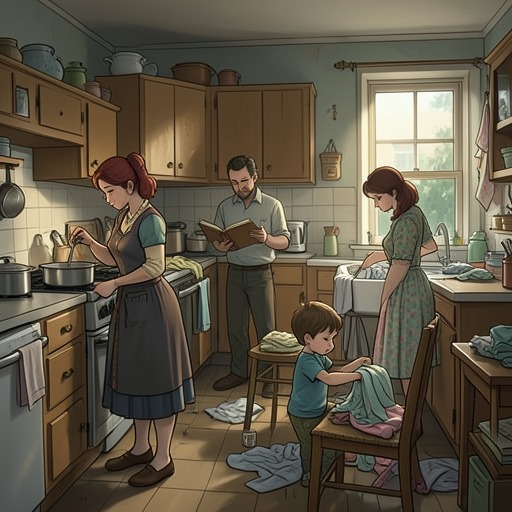
By Chapter thirty-four, breakfast has become a regular tradition in the Sharoth household. Victor’s lesson is not recorded as an isolated supernatural episode but as part of a repeated household practice that includes Titan dropping the morning’s copy of the Forgotten Times beside Bael-Sharoth and curling beneath the table in hopes of falling bacon. Victor’s influence thus persists even when the available scene does not place him directly at the center. The breakfast table becomes a shared domestic space where cooking, reading, and Titan’s anticipation of scraps coexist, and Victor’s culinary intervention helps establish that routine.
Victor’s preferred home also becomes clear through his reaction to Bael-Sharoth and Maharet Flameheart’s intimacy. After the couple’s private encounter on the kitchen floor, Victor hides in the cookie jar he now calls home. His retreat is an act of embarrassed self-protection: even a ghost, the narrative observes, can be made to blush by what he witnesses. The cookie jar transforms the haunting into a quasi-household occupancy, giving Victor a small, recognizable domestic refuge while preserving his comic distance from the couple.
Characterization and Narrative Function
Victor is defined by a productive contradiction. He is physically vulnerable to Bael-Sharoth’s demon strength, yet intellectually superior in the kitchen; he is introduced through ghostly harassment, yet becomes the source of nourishment; and he possesses the status of a world-renowned chef while being compelled to teach basic egg preparation to someone who repeatedly burns breakfast. These reversals make him more than a generic ghost. His authority is repeatedly challenged in the same space where his expertise is indispensable.
His scenes also defamiliarize an ordinary household task. Cooking eggs is treated with the seriousness of a supernatural negotiation, complete with disappearing ingredients, a salt-and-glass revelation, a cast-iron blow, a shopping expedition, controlled oven temperature, warmed stoneware plates, Gruyère, ham, espelette, and spiced sour cream. The result is not simply a joke about Bael-Sharoth’s incompetence. It is a comic reordering of power in which a haunting becomes a lesson, violence becomes instruction, and breakfast becomes the basis for continuity within the household.
Victor’s final position is therefore neither defeated antagonist nor conventional mentor. He is an unwilling but effective culinary authority whose presence helps make the Sharoth home feel inhabited, repetitive, and socially legible. His disappearance when Maharet Flameheart appears, his later association with the breakfast tradition, and his retreat into the cookie jar all preserve the same essential pattern: Victor remains supernatural, but domestic life has given his haunting a role, a routine, and a place to belong.